This year it seems I had a bigger tech focus and didn’t do the best job at capturing the daily fun tidbits of learning.
When every line of code I write (ahem generate ahem) these days has been checked by a LLM, I can’t lie and say this year’s TIL has also been grammatically and fact checked. If there still is an issue, take it up with Claude (see Fact 22).
-
SLC
- An acronym for simple, lovable and complete
- Competes with the idea of a MVP - minimum viable product
-
Tog’s Paradox
- Products aiming to simplify a task for users tend to create the need for new and more complex tasks
- An explanation as to why user requirements are always changing as the product is being delivered
- Named after Bruce Tognazzini
-
Rubbing mud
- MLB doesn’t use brand new baseballs, they prep the ball with mud to remove the sheen on the leather
- A special variety of muck was discovered by Lena Blackburne in Burlington County along the Delaware river was used to prep the balls that had enough texture and didn’t turn the balls black. It has been used since 1938 (over 85 years)
- The location of the muck hole is a secret to this day https://baseballrubbingmud.com/
- A paper on the mechanism of rubbing the mud https://www.pnas.org/doi/10.1073/pnas.2413514121
-
Whorfianism
- The idea that language can shape the way we think
- Also known as the Sapir-Whorf hypothesis
- A controversial hypothesis that states that the structure of the language can affect how the speaker of that language understand the world
- An example is Eskimo has many more words for snow, and that is related to their environment
-
Snowclone
- A cliched phrase where one or more words can be substituted to express a similar idea in a different context
- Derived from the journalistic cliche that referred to the numerous number of words the Eskimos have for snow
- Some examples
- The mother of all pizzas (based on the phrase the mother of all battles)
- X is the new black
- To X or not to X
- Keep X and carry on
- XaaS
-
Those dots on the car glass
- They are called “frits” and they are ceramic-based enamel baked into the glass during manufacturing to help with temperature gradient (see what they look like)
- Better heat spreading helps the glass to be undistorted and prevents cracking
-
That hole on the elevator door
- There is a small dime-sized hole on some elevator doors
- And its used to open the doors by security or emergency responders or maintenance
- Requires a special key called hoistway door unlocking key
-
Mariko Aoki Phenomenon
- It is a Japanese expression that refers to the sudden desire to want to poop upon entering a bookstore
- Not yet understood if this is based on any scientific backing and is currently just a urban myth
- One theory is the smell of ink/paper has a laxative effect or triggered by reading at home on the toilet
-
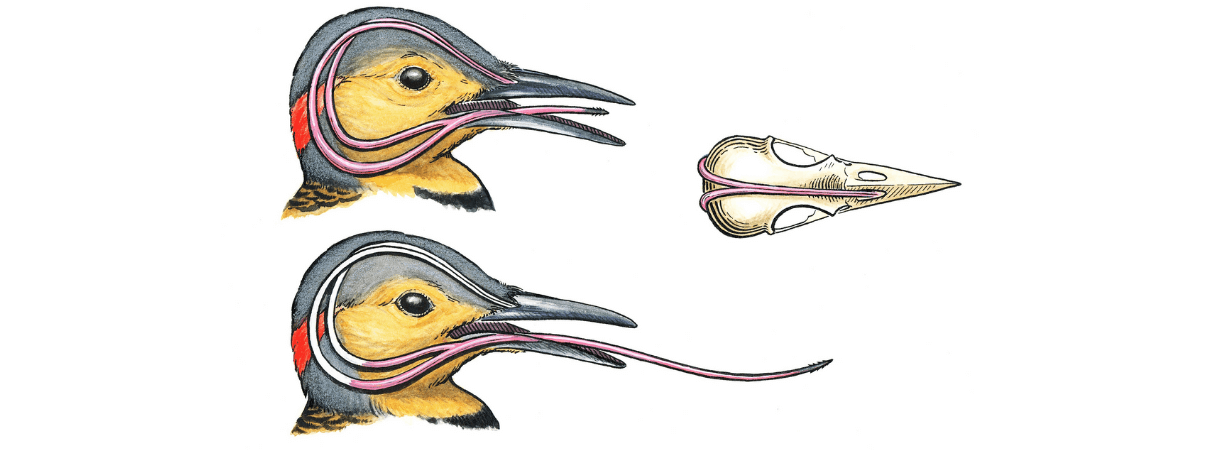
Woodpecker’s Tongue
- Wraps around its head, though recent research debates whether this anatomical feature actually provides shock absorption or if protection comes from the bird’s small brain size (see the anatomy)
- Reminds me of those neck braces football players wear for concussion protection
-
Fermi estimation
- Back of envelope type problems that require the person to use common sense, order of magnitude and good assumptions to come up with the rough answer
-
Skulduggery
- A new word that I learned, it means underhanded or unscrupulous behavior
-
Rolex
- Name changed from Wilsdorf & Davis in 1915 during WW I due to anti-German sentiments
- Moved to Geneva, Switzerland in 1919 partially due to post-war taxes in UK and also being closer to the movement manufacturing
- Oyster is a term was created for marketing the first waterproof and dust-proof design that resembles an oyster shell that hermetically sealed
-
Why are there so many Swiss based watch makers?
- There is a Swiss manufacturing system called “Établissage” where a complex system is broken into individual components and an independent specialists focuses on that component only, then assembled into finished watches by a separate entity
- Geneva was also the center of activity for the Protestant Christians led by John Calvin, who was focused on moral uprightness and they don’t have things like ornamental jewelry so the workshops are focused on watchmaking because it serves a functional purpose
-
Cod
- Large, edible sea fish, particularly those from the genus Gadus
- The word origin is unclear, though one theory suggests it may relate to the “cod end” (bag-like end) of fishing nets where this bottom-dwelling fish was often found
-
Witching hour
- Is a time at night when supernatural events occur according to folklore
- Definitions vary, but typically the hour after midnight or 3am to 4am
- Now it colloquially refers to the last hours of stock trading in the US between 3pm and 4pm when there is an above average volatility
- Triple witching hour refers to the last hour on the third Friday of March, June, September, and December when stock index futures, stock index options, and stock options all expire resulting in significant volatility
- NFL witching hour is the end of the Sunday morning or afternoon games when close games are determined
-
Auction types
- English auctions: prices keep rising until a single highest bidder wins
- Dutch auctions: prices start high and keeps lowering until a bid is accepted
- First price blind auctions: bidders all submit bids secretly and highest bidder wins and pays that price
- Second price blind auctions: blind auction as well but the highest bidder pays the second highest price
- Encourages the “real” price to be bid
-
Fondo
- Also known as “gran fondo”, is a long distance cycling event for all levels. Typically 75 to 150 miles long.
- Italian for “big ride”
-
Stoops
- Stair entries to houses, common in New York, Boston, Philly, built to avoid horse manure (classic NYC stoops)
- The roots is from Dutch architecture, known as “stoep” which means step or sidewalk which was built in Netherlands to avoid floods
- Dutch settlers brought this influence to Northeastern US when they colonized it
-
Does reading or playing video games lead to near-sightedness?
- I’ve always been told by my parents that reading or playing video games can lead to near-sightedness or myopia
- Recent studies have shown correlation between lack of outdoor play and natural light exposure with increased risk of myopia as an adult (source)
- Which might have been the underlying reason for reading being linked to near-sightedness
-
Liar’s Poker
- A game played at Solomon Brothers (a bond firm)
- It was said the bond traders believed this game most mimics the bond market
- It is similar to “Liar’s dice”, except the numbers are generated by the serial numbers on the US one-dollar bills
-
Markov Chains
- Law of large numbers: Average outcome gets closer to expected numbers with independent events
- This was only proved for independent events, so all of probability relied on this independence assumption as well, until Andrey Markov
- Andrey Markov (socialist, atheist) and Pavel Nekrasov (tsar, religious) argued whether mathematics can explain will of god and free will
- Nekrasov: if you see the LLN then there must be independent events
- Used Belgian Marriage dataset and other social statistics to argue that because we see convergence of statistics which is observing the LLN then the decisions causing such social events (marriage, crimes, etc) must be independent
- Free will, thus, can be measured
- Markov: set out to prove dependent events can also follow the LLN
- Used a poem to train a text prediction model and found that the probability of two letters that occurred is different than their expected average assuming independence
- Built a model to make this dependent event prediction which is the Markov Chain and showed that it can follow the LLN as well
- “Free will is not necessary to do probability” * Markov proved that observing LLN statistics does not mean independent events thereby showing that LLN can be true for dependent events as well
- Law of large numbers: Average outcome gets closer to expected numbers with independent events
-
Claude Shannon
- “Father of information theory” or “Father of digital age” and creator of “bit”
- First to use Boolean algebra
- Designed and built a learning machine called Theseus. Which is a maze with a mechanical mouse that learns how to search for a target using the shortest path (see Theseus at MIT Museum)
- Anthropic’s AI model is named after him
-
Resume driven development
- Skill development based on creating a better resume
- Using complicated tech stacks, over engineered design in order to look impressive
- Sometimes I see this in resume screenings and not something I agree with, I subscribe to the idea behind the quote * “ideas should be so simple that people are upset that they didn’t come up with it”
-
Shibboleth
- Like a password that indicates you are part of a distinct group, usually a phrase or a word
- Originates from a Hebrew word that means the part of the plant that contains the seed
- Because of how Ephraimates pronounced
shin, it was used to distinguish the survivors apart after invading them - Related to this word is “Scribbeleth”, which is messy handwriting that can distinguish a group like doctors
- Related to this is also the trending term “6-7”
-
6-7
- A term that is almost shibboleth for gen-z/alpha to distinguish those “in the know”
- It evolved from calling it out when 67 happens naturally in a conversation to acknowledging it without actually saying the phrase
- It has gone through “semantic bleaching” and lost its original meaning to the point that when Googling it, it refers to either a high crime street in Chicago or the height of Lamelo Ball as he endorsed popular video edits of his highlights
- The original meaning from the Skrilla song is intentionally ambiguous - one theory suggests it refers to a police radio code for a dead body
-
Semantic bleaching
- Linguistic process where a word or term loses its original spiciness and becomes weaker and generic over time
- Some examples: rawdogging, literally
-
Manufacturing tanks in peace times
- The concept that it is important to maintain some level of production capacity for critical industries during peacetime to preserve institutional knowledge and prevent the loss of specialized manufacturing capabilities
-
Ortega Hypothesis vs Newton Hypothesis
- Ortega hypothesis is that the bulk of science advancements made by average scientists over time/volume
- Newton hypothesis is that advancements are made by a few great scientists
- Ironic thing is that it is named after Jose Ortega y Gasset who wrote in “The Revolt of the Masses” that astoundingly mediocre men of narrow specialties do most of the work of experimental science and he believed that progress is made by geniuses building on each other’s work
- Neither hypothesis have been definitively proven wrong
-
Bul Mong
- Korean for “staring at fire without thinking”
-
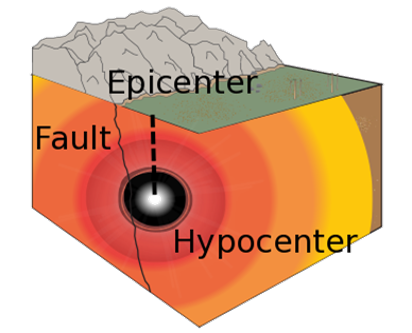
Hypocenter vs epicenter
- Hypocenter is the underground focus point of an earthquake
- Epicenter is the above ground point where the earthquake happened (see the diagram)