Author: Juan de Dwios Ortuzar and Luis G. Willumsend
Tags: #transportation #books #academic
👆 Short Summary (1 takeaway)
Comprehensive review of the historical and current state of practice for transportation modelling
🧐 Why I am reading this book?
To review the core concepts of transportation modelling in preparation for new job at Tesla
February 20th, 2021 5 month in, I have not really made use of this knowledge actively. There are some tangential thought experiments that brings some up but maybe 20% useful
📖 Chapter reviews
1.0 Introduction
1.1 Transport Planning and Modeling
Globalization and telecommunications are two major trends that transformed the 21st century
A model is only realistic from a particular point of view
1.2 Characteristics of Transport Problems
The demand for transportation is derived, people don’t travel (except sightseeing) for the sake of travel, it is often to satisfy a need (work, school, shopping)
A good transportation system widens the opportunities to satisfy these needs
Transport demand has strong dynamic elements, it peaks with direction, time, and space
This makes modelling demand interesting but also difficult
The supply for transportation is a service and not a good
Thus, you can’t stock it and prepare it for high demand
Transportation systems are comprised of two things: fixed assets (infrastructure) and mobile units (vehicles)
These two things and a set of rules on how these two things coordinate makes up any transportation system
Investment in transportation infrastructure is lumpy and takes a long time to carry out
Also creates disruption to the existing service
Most importantly, infrastructure for transportation is largely political for most countries
Congestion occurs when the demand for the infrastructure approaches or reaches the capacity it can service
There is a perceived cost of congestion for all users due to the longer travel time
There is also an external cost added to all other users with each additional user
The role of transportation planning is to satisfy both short-term and long-term supply and demand
Development trap occurs when car-ownership increases, people can live and work irrespective of transit development which leads to urban sprawl - low-density development that is ineffectively served by public transit, which leads to further congestion.
1.3 Modeling and Decision Making
There are 2 main decision making paradigms
Substantive rationality: people know their objective and evaluates the different choices to achieve their objective 2. This assumption is has problems with specifying the objective beyond cost-related measures and alienation of decision makers who do not accept this analytical style of thinking
Muddling through: people mix various high-level objectives, intermediate goals, immediate actions as an approach to make decisions
It is much better to be roughly right than precisely wrong - John Maynard Keynes
There are 4 main dimensions of model resolution
Space: from zones to addresses
Unit of analysis: from trips to household/person stratas to synthesized individuals
Behavioural responses: route choice actions, changes in time of travel, mode, destination, tour frequency, and even land use and economic activity impacts
Time: can be discrete or continuous. Discrete time can cover a full day (national models), time periods or smaller time intervals. Continuous time can allow for dynamic handling of traffic and behavioural responses
1.4 Issue in Transport Modeling
Main usage of models in practice is for conditional forecasting which is producing estimates for a dependent variables based on independent variables
Aggregate and disaggregate modelling
a key design decision based on the availability of data and the need for the model
Aggregate models were the norm up to 1970s, but they are criticized for inflexible, inaccurate and costly
Dissagregate models started to be popular during 1980s, but they require high statistical and economietric skills from the modeller
The main difference lies in the treatment of the description of behaviour, particularly during the model development process
Cross-section or time-series
Cross-section approach assumes that a measure of the response to incremental change may simply be found by computing the derivatives of a demand function with respect to the policy variables in question
this brings up two drawbacks, a given cross-sectional data set may correspond to a particular ‘history’ of changes and data collected at only one point in time will usually fail to discriminate between alternative model formulations
This led people to believe that where possible, longitudinal or time-series data should be used to construct more dependable forecasting models
Revealed and stated preferences
Observations on varies circumstances and reactions in transportation is often not available, and is was almost axiomatic that modelling transport demand should be based on revealed preference data
Stated preference techniques, borrowed from market research, were put forward as a way of experimenting with transport-related choices
1.5 Structure of the Classic Transport Model
Zone and network system -> Collection of planning and transportation data (base year and forecast) -> Trip generation -> Trip distribution -> Mode split -> Assignment
Not the only structure but one of the most common
1.6 Continuous Transport Planning
Models needs to be used within a decision process:
Formulation of the problem: a mismatch between expactations and perceived reality with reference to ojectives, standards, and constraints
Collection of data: gather information of the current state
Construction of an analytical model: choosing the simplest approach to describe the system of interest
Generation of solution: from experience to automated optimization
Forecast future values of the planning variables
Testing the model and solution: under different scenarios to confirm its reasonableness
Evaluation of solutions: using a combination of economic analysis, political judgement and engineer thinking to judge the recommendation
Implementation of the solution
2.0 Mathematics Prerequisite
2.3 Matrix Algebra
Multiplication is non-commutative, the columns and rows are multiplied and summed
Inverse of a matrix is such that B−1B=BB−1=I and may not always exist
If this exists, B is non-singular
Division between A and B is the pre- or post- multiplication of the inverse of B
2.4 Logarithmic and Exponential Function
loge(x) is the integral of x1
e is defined as loge(e)=1
log(1)=0
log(uv)=log(u)+log(v)
ex is defined as the number w such that log(w)=x
2.5 Elementary Mathematical Statistics
Expected value is the weighted average times probability
==Normal distribution has a mean of 0 and variance of 1==
==Central Limit Theorem states if we have n variables x that distribute with any distribution with finite variance, it can approach normal distribution after “standardizing” and if n is greater than or equal to 30==
Maximum likelihood is the most well-known and often used method of estimating parameters to deduce population characteristics from sample data
Good estimators are unbiased, or at least asymtotically unbiased
They are efficient, minimal variance
They are consistent
Hypothesis testing is based on taking a hypothesis and using to sample to verify that if null Hypothesis is true and we can accept the null Hypothesis or the null Hypothesis is false and we can reject the null Hypothesis
The Type I and II errors occur when we see the opposite
It is ideal to have low probability of both errors, but it is impossible to decrease the likelihood of one error without increasing the likelihood of the other error
3.0 Data and Space
3.1 Basic Sampling Theory
The difficulties of sampling are ensuring the sample is representative, and able to extract valid conclusions from this sample
Sampling method are usually based some random sampling:
Simple random sampling
Stratified random sampling
If these methods do not have enough data to do representative sample, then one might use choice based sampling
This method can be useful with less data, but can form biases
Central limit theorem postulates that the estimates of the mean from the a sample tend to become distributed Normal as the sample size increases
3.2 Errors in Modelling and Forecasting
The goal of modelling is forecasting, thus an important problem is to find which combination of model complexity and data accuracy best fits the required forecasting precision and study budget
Errors that affect this are:
Those that could cause even correct models to yield incorrect forecasts (errors in the prediction, transference and aggregation errors)
Those that actually cause incorrect models to be estimated (measurement, sampling and specification)
Measurement errors are inherent in the process of measuring the data, can be improved with better data-collecion process
Another common problem is the perception error inherent to the traveller when they report data
Sampling errors arise due to finite data sets, and to improve them requires squared effort
Specification errors are due to the misunderstanding or lack of understanding of the problem which can cause modellers to include irrelevant variables, omission of relevant variables, not allowing for taste variations on the part of the individuals, inappropriate model formulation
Transfer errors occurs when the model developed for a specific context is inappropriately applied in another (time and space), although the ones from temporal transfer might need to be accepted
Aggregation errors are the result of forecasting for a group of individuals when the modelling was estimated on individuals
The duality of model complexity and data accuracy is a constant struggle for modellers
Concentrate the improvement effort on those variables with a large error
Concentrate the effort on the most relevant variables
3.3 Basic Data-Collection Methods
This chapter contains information to help design a travel demand survey of various kinds, which is not relevant for me right now
Current best practice suggests that the data set should have the following:
Consideration of stage-based trip data, relate specific modes to specific locations/times of day/trip lengths
Inclusion of all modes of travel
Measurements of highly disaggregated levels of trip purposes
Coverage of the broadest possible time period
Data from all members of the household
Information robust enough to be used even at a disaggregate level
Part of an integrated data collection system incorporating household interviews as well as origin-destination data from other sources such as cordon surveys
Data sources include:
Household surveys, used to generate data for trip generation, distribution and mode split
Intercept surveys: external cordons, used to catch people crossing the study border, and internal cordons
Traffic and person counts, for calibration and validation
Travel time surveys, for calibration and validation
Other related data
Land-use inventory which gives the modeller information on zone types, parking spaces
Infrastructure and services inventories which gives public and private transport networks, fares, frequencies, traffic signals
Information from special surveys on attitudes and elasticity of demands
3.4 Stated Preference Surveys
RP data may be limited in several ways
Not enough data on alternative choices to give variability
Not enough information will be revealed to analyze secondary factors such as security, decor, and publicly displayed information on a user’s decision
Lack of data for entirely new modes without good substitute
Contingent Valuation (CV), conjoint analysis (CA) and stated choices (SC) are three SP techniques with SC being the most common
CV deals solely with eliciting willingness-to-pay information for various policy or poduct options
4 types of CV questions are direct questioning, biding games, payment options and referendum choices
CA examines the preferences, and even WTP, not only for the entire policy as a whole, but also of the individual characteristics of the object(s) under study
CA surveys have heavy criticism, so it is not often used
SC is similar to CA insofar as a set of alternatives are presented, but instead of ranking them, the respondents are asked to choose their preferred alternative from among a subset of the total number of hypothetical alternatives constructed by the analyst
SC also typically presets a small subset of all available alternatives, changing this subset during the survey
Biggest issue is the how much faith can we put on individual actually doing what they state they would do
Early on, in 1970s only 50% of the people seem to actually do what they state and later on this improved
This could be because the data-collection method improved
3.5 Network and Zoning Systems
Zoning system is used to aggregate the individual households and premises into manageable chunks for modelling purposes’
zone size must be such that the aggregation error caused by the assumptions that all activities are concentrated at the centroid is not too large
should be compatible with other administrative divisions, particularly census
should be homogeneous as possible in their land use and/or population
zone boundaries must be compatible with cordons and screen-lines
shape of the zones should allow for easy determination of their centroid connectors
zones do not have to be of equal size
Network is a key component of the supply side of modelling
normal practice is to model the network as a directed graph
links are characterized by several attributes such as length, speed, number of lanes and so on
one should include in the network at least one level below the links of interest
Most current assignment techniques assume that drivers seek to minimize a linear combination of time, distance, and tolls, or generalized cost of route choice
4.0 Trip Generation Modelling
This stage predicts the total number of trips generated by each origin zone and attracted to each destination zone
start with the trips of the individuals or households who reside in each zone
directly related with some properties of the zones (population, employment, number of cars, etc)
Viewed as a trip frequency problem
how many shopping trips will be carried out by this person type during a representative week
4.1 Introduction
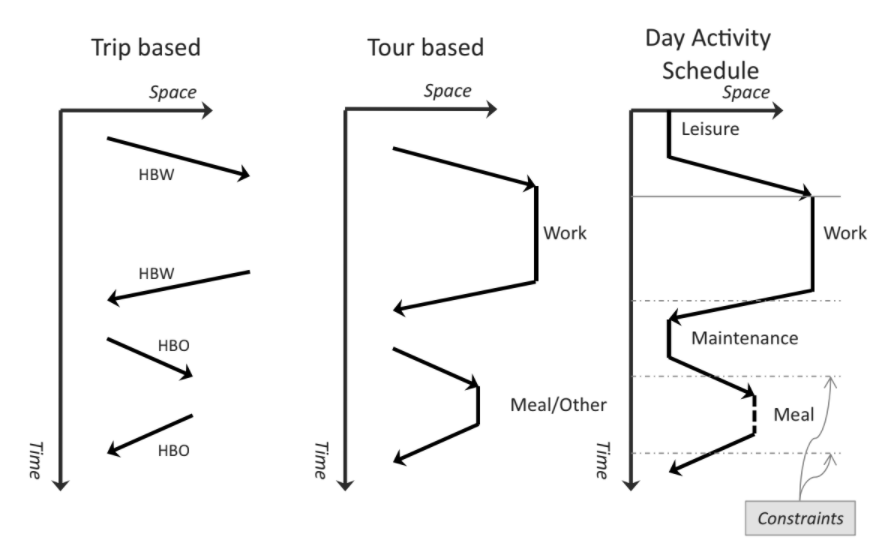
Sojourn is a short period of stay in a particular location, is usually associated with a purpose (work, study, shopping, leisure)
Activity is an endeavor or interest often associated with a purpose but not necessarily linked to a fixed location
It has been found in practice that a better understanding of travel and trip generation models can be obtained if journeys by different purposes are identified and modeled separately
travel to work
travel to school
shopping trips
social and recreational journeys
escort trips
other journeys
Mandatory (compulsory) trips are work and schools trips, while discretionary (optional) trips are the other types
Classification with respect to time of day is also useful, there are distinct traits for the AM/PM/Offpeak periods
Classification with person type or household type such as income level, car ownership, household size, family structure is also important
Trip production factors
Income, car ownership, family size, household structure, value of land, residential density, and accessibility
Accessibility have been studied for its affect on trip generation, but is rarely used in practice even though it can give valuable elasticity from changes in the transportation system
Trip attraction factors
roofed space for industrial, commercial, and other services, zonal employment, and accessibility
For Tesla, modelling trip attraction with supercharging stations could be interesting. Also, trip production should have a robust model for non-tesla behavior, so one can study the shift of tesla users and see elasticity on the tesla trip generation
Freight trip production and attraction factors
number of employees, number of sales, roofed area of firm, and total area of firm
Growth factor modelling is the simplest technique for trip generation
Future Trips = Growth Factor x Current Trips
Growth Factor = f(Future population, income, car ownership)/f(Current population, income, car ownership)
Mainly used to predict future number of external trips because this is a crude method and is prone to overestimate but requires little data
4.2 Regression Analysis
Moving beyond growth factor modelling, one can use linear regression to find the relationship between the number of trips produced or attracted by zone and average socioeconomic characteristics of the households in each zone
this can only be successful if the inter-zonal variations adequately reflect the real reasons behind trip variability. A major problem is that the main variations in person trip data occur at the intra-zonal level
it is common to have a large intercept value from estimation, which means the equation may be rejected. One would expect the estimated regression line to pass through the origin
null zones needs to be excluded from analysis
zone totals vs zone means. The use of aggregate variables implies that the magnitude of the error actually depend on zone size, this heteroskedasticity has indeed been found in practice. Need to apply multipliers to reduce heteroskedasticity.
In the early 1970s, it was believed that the most appropriate analysis unit was the household
little practical success
Linear regression model assumes that each independent variable exerts a linear influence on the dependent variable
There are two methods to include non-linearity behavior
transform the variables in order to linearise their effect (log, ln, exp)
use dummy variables to discretize continuous variables into separate variables
Because trip generation models are often estimated on better variables and uses better data, to ensure generation totals match production totals it is common to scale the generation side to match the production side
4.3 Cross-Classification or Category Analysis
A popular method in the UK, estimating the response (e.g. the number of trip production per household for a given purpose) as a function of household attributes)
The art of the method lies in choosing the categories such that the standard deviations of the frequency distributions are minimized
The advantages are
cross-classification groupings are independent of the zone system of the study area
no prior assumptions about the shape of the relationship are required
relationships can differ in form from class to class
The disadvantages are
model does not permit extrapolation beyond its calibration strata, although the lowest or highest class may be open ended
no statistical goodness-of-fit measures for the model
unduly large samples are required, accepted wisdom suggests that at least 50 observations per cell are required to estimate the mean reliably
there is no effective way to choose among variables for classification
if it is required to increase the number of stratifying variables, it might be necessary to increase the sample enormously
Read more in detail to see improvements for this basic model to have some statistical attributes extracted
The person-category approach is an alternative to the household-based model which offers some advantages
Biggest limitation is the difficulty of introducing household interaction effects and household money costs and money budgets into a person-based model
4.4 Trip Generation and Accessibility
Classic specification of the four-stage model does not include trip generation in the iterative procedure, this means that network changes does not affect the number of trips generated
To solve this, modellers have attempted to incorporate a measure of accessbility into trip generation equations
replace O=f(H) by O=f(H, A) where H is household characteristics and A is a measure of accessibility by person type
accessibility measures take the general form A = sum(f(E, C)) where E is a measure of attraction of a zone, and C is the generalized cost of travel, a typical analytical form is: A = sum(E^alpha * exp(-beta * E))
But this has been unsuccessful in practice, insignificant or the wrong sign
4.5 The Frequency Choice Logit Model
Daly (1997) used the Logit form to predict the total number of trips by calculating the probability that each individual would choose to make a trip. Total travel volume can then be obtained by multiplying the number of individual of each type by their probabilities of making a trip
The preferred form of accessibility at the destination (or mode) choice model is the logsum
The stop-go trip generation model forms a hierarchical relationship for the individual to determine whether it will continue its tour at each stop or return home
This may be a key formulation to use for tesla in order to test how the availability of supercharging stations will change a user’s journey length
4.6 Forecasting Variables in Trip Generation Analysis
It has become a topic of interest for the modelling group to be able to capture social circumstances in which individuals live through behavioral sceince
One way to achieve this is to develop a set of household types that effectively captures these distinctions and then add this measure to the equations predicting household behavior
consistent with the idea that travel is a derived demand and that travel behavior is part of a larger allocation of time and money to activities in separate locations
important stages in households for travel behavior might be
appearance of pre-school children
time when youngest child reaches school age
time when a youth leaves home
time when all the children left home but the couple has not yet retired
time when all members of a household have reached retirement age
Old trend of aging population which may result in less travel might not hold in the future with the advent of autonomous vehicle
Huge opportunity to study how autonomous vehicle technology change travel behavior, if this increases the number of discretionary trip making?
4.7 Stability and Updating of Trip Generation Parameters
A key and often implicit assumption of using cross-sectional data is that the model parameters will remain constant between the base and design years
it is found in several studies that this cannot be rejected when trips by all modes are considered together
other analyses have reported different results, which has the following implications
if there is non-zero elasticity of car trip rates to fuel prices, the usual assumption of constant trip rates in a period of rapidly increasing petrol prices could lead to serious over-provision of highway facilities
trip rates of electric vehicle and gasoline vehicle is different depending on the external prices of electricity and oil
Then, it is clear that any variables with longitudinal effects on trip rates requires careful consideration as it has fundamental importance
but this requires data where only cross-sectional data is available
Geographical stability (transferrability) is another important attribute of a robust travel demand model
it would suggest the existence of certain repeatable regularities in travel behavior which can be modeled
it would indicate a higher probability that temporal stability also exists
it may allow reducing substaintially the need for costly full-scale transportation surveys on different areas
It is equally clear that not all travel characteristics can be transferable (i.e. work trip duration), but trip rates should not be seen as unrealistic
Bayesian techniques can be used to update the parameters of an estimated model from one area to be applied to another area
requires a small sample of data in the application area
considers a prior distribution (estimated area) and new information to create a posterior distribution corresponding to eh application area
5.0 Trip Distribution Modelling
There are two ways of representing the pattern of travel
a trip matrix which represents the origin and destination of the trips
a PnA matrix which represents the production and attraction of the trips
Trip distribution is often seen as an aggregate problem with an aggregate model for its solution, however, the choice of destination can also be treated as a discrete choice (disaggregate) problem and treated with models at the level of the individual
Discrete choice model might be important for modelling existing Tesla users, since they may have strong considerations for proximity to charging station?
A generalized cost is often computed between all the O-D pairs
including travel time, wait time, walking time, fare, terminal cost, modal penalty
linear combination of these and weights
5.2 Growth Factor Methods
Uniform growth factor can be applied to forecast base year trip distribution into the future
often unrealistic over longer periods
Singly constrained growth factor
where information about the origin or destination is known
Doubly constrained growth factor
Fratar or Furness methods is used to iteratively adjust two factors to “balance” the targets on both the origin side and destination side
Advantage of these methods is that they are clear and simple - makes direct use of observed trip matrices
Disadvantage of these methods is they are probably only useful in the short term and can’t capture changes to the transportation system
5.3 Synthetic or Gravity Models
First used by Casey (1955) to model shopping trips between towns in a region
The popular version of this function is now a combined function of a negative exponential and power functions
The generalized function of travel cost looks like this:
f(cij)=cijα∗exp(−β∗cij)
Tij=Ai∗Oi∗Bj∗Dj∗f(cij)
A more general version accepts empirical values and depend only on the generalized cost of travel in the form of TLFD but instead of coming up with a single value for alpha and beta, there are as many parameters as there are bins
Key assumption made by this method is that the same shape or TLFD will be maintained in the future
5.4 The Entropy-Maximizing Approach
Given a system with a large number of distinct elements, to describe such a system one would need a complete specification of its micro states. However, it is practical to work in meso-state, which can be arrived at many different micro states. Then there is a even higher level of aggregation, macro state, which is where one makes reliable observations about the system
The basis of this method is to accept that all micro states consistent with our information about macro states are equally likely to occur
this is done by expressing our information as equality constraints in a mathematical program
the most probable meso state is that one that can be generated the most often, so if we have a number of micro states WTij and macro state T_ij one can optimize the following
W{Tij}=sum(Tij!)T!
Taking log, then approximating and taking the derivative one gets:
log(W′)=−∑(Tijlog(Tij)−Tij)
Thus, by maximizing log(W’) enables us to generate models to estimate the most likely meso states
This formulation with the appropriate constraints can be used to derive the Furness model or gravity model
5.7 Other Synthetic Models
An extension of the gravity model is to account for not just the deterrent effect of distance but also for the fact that the further away one is willing to travel the greater the number of opportunities to satisfy your needs
Fang and Tsao (1995) suggested a model called self-deterrent gravitymodel with quadratic costs:
exp(−β×Cij×−λ×Tij×Cij)
Another model is the intervening opportunities model, which says trip making is not explicitly related to distance but to the relative accessibility of opportunities for satisfying the objective of the trip
consider first a zone of origin i and rank all possible destinations in order of increasing distance from i
then look at one O-D pair where j is the mth destination in order of distance, there are m−1 alternative destinations actually closer to i
a trip maker would certainly consider those destinations as possible locations to satisfy the need given rise to the journey, which are the intervening opportunities influencing a destination choice
let α be the probability of a trip maker being satisied with a single opportunity, then the probabiliy of being attracted by a zone with D opportunities is αD
consider probability qim of not being satisfied by any of the opportunities offered by the mth zones, which is not being satisfied with first, second, or mth
qim=qim−1×(1−αDim)
q(x)=Ai×exp(−αx) where x is the cumulative attractions of the intervening opportunities
This formulation starts from a different first principles which is interesting
Not often used in practice because the theory behind it is less well known, can be difficult to handle when implemented, the advantages over gravity is not overwhelming, no suitable software
6.0 Modal Split and Direct Demand Models
6.1 Introduction
It can be treated as an aggregate problem similar to trip distribution, and we can observe how far we can get with similar tools
Examine direct demand models - a method to estimate generation, distribution and modal split simultaneously
Examine the need for consistency between parameters and structure of distribution and mode choice models
Often disregarded by practitioners at their peril
The issue of mode choice is arguably the most important element in transport planning and policy making - thus it is important to develop and use models which are sensitive to those attributes of travel that influence individual choices of mode
6.2 Factors Influencing the Choice of Mode
Characteristics of the trip maker
Car availability and/or ownership
Possession of a driving licence
Household structure
Income
Decisions made elsewhere, take children to work
Residential density
Characteristics of the journey
Trip purpose
Time of day
Whether the trip is alone or with others
Characteristics of the transport facility
Components of travel time
Components of monetary cost
Availability and cost of parking
Reliability of travel times and regularity of service
Comfort and convience
Safety, protection, security
The demand of the driving task
Opportunities to undertake other activities during travel
A good mode choice model would be based at least on simple tours and should include factors such as if one takes a car for the first leg then it is likely for one to use the car on the subsequent legs
6.3 Trip-end Modal Split Models
This was used in the past, particularly in the USA
Personal characteristics were thought to be the most important determinants of mode choice
So mode split was immediately done after trip generation when the different characteristics of the individuals could be preserved
It was part of “predict and provide” approach to transport planning
Outdated and wrong in todays perspective
Mode choice was dependent only on income, residential density and car ownership
This model can be accurate in the short term, but is defeatist in the sense of being insensitive to policy decisions
Integrates the trip characteristics because it is applied post-distribution but can be difficult to include user characteristics because the info may be lost in the trip matrix
Initially, empirical relationships with in-vehicle travel time was used to estimate what proportion of travellers would be diverted to use a longer but faster bypass route
S-curve
Another approach is to use a version of Kirchhoff formulation in electricity
The proportion of trip makers between i and j that chooses mode k as function of the respective generalized cost Cij is given by: Pijk=∑(Cijk)−n(Cijk)−n
Where n is a parameter to be calibrated or transformed from another location or time
This is not too dissimilar from the Logic equation
6.5 Synthetic Models
Entropy-maximizing approach can be used to generate models of distribution and mode choice simultaneously - which leads to the Logit form
Logit form
Pij1=∑exp(−βCijk)exp(−βCij1)
The parameter β plays two roles: it acts as the parameter controlling dispersion (trip distribution) and also in the choice between destinations at different distances (mode choice) from the origin
So a more practical joint distribution/modal-split modal has the form (Wilson 1974) which splits out β into two separate parameters
Where Kijn is the composite cost of travelling between i and j asp received by person type n
Williams (1977) showed that the only correct specification of K is
Kijn=λn−1log(∑(exp(−λnCijk)))
βn≤λn
The last equality is vital to ensure that the structure G/D/MS/A can be used, otherwise if β>λthen the structure G/MS/D/A could be the correct one
==For many applications these aggregate models remain valid and in use. However, for a more refined handling of personal characteristics and preferences we now have disaggregate models which respond better to the key elements in mode choice==
For a multi-modal scenario, the N-way structure is popular in disaggregate modelling work
but it assumes all alternatives have equal weight which can lead to problems if alternatives are correlated
Another structure is the added-mode structure, which was popular in the late 1960s and early 1970s
But this has shown to give different results depending on which mode is taken as the added one
Also it has been shown that the form with good base year performance does not translate in forecasts
The standard practice in the 1960s and early 1970s was the nested structure where alternatives with common elements are grouped together
Shortcoming of this was the composite cost for the “public-transport” mode were normally taken as the minimum of costs of the bus and rail modes for each zone pair and that the secondary split was achieved through a minimum-cost “all-or-nothing” assignment
This implies an infinite value for the dispersion parameter of the sub-modal split function
Calibrating a binary logit model with known proportions of choosing each mode and the cost of travel for all OD pairs across both modes is done with linear regression with the LHS of the following equation as dependent variable and the cost difference as the independent variable
log[(1−P1)P1]=λ(C2−C1)+λδ
Where λ is the dispersion parameter and δ is the modal penalty (assumed associated with the second mode)
Calibrating a hierarchical modal-split model involves recursion using maximum likelihood estimation (as opposed to least square estimates). Data is grouped into suitable cost-bins
First calibrate the sub-modal split using the technique above
Then, segment trips that have a choice in modes into bins
Calculate the weighted cost of each bin
The probability of choosing a mode for each bin can be represented as:
Pk=[1+exp(−Yk)]1
Yk is the representative cost of the bin
The logarithm of the likelihood function is:
L=constant+∑[(nk−rk)log(1−Pk)+rklog(Pk)]
nk is the observed number of trips in the cost-difference interval
rk is the observed number of trips by the first mode in the interval
Then by taking the partial first and second derivatives w.r.t various parameters, a search algorithm can find the maximum
6.6 Direct Demand Model
Alternative to sub-models, this approach is to create one single model that consolidates generation, distribution and mode choice
Direct Demand Models use a single estimated equation to relate travel demand directly to mode, journey and person attributes
Quasi-Direct Models employ a form of separation between mode split and total OD travel demand
Direct Demand Models
Earliest forms use multiplication, there are different versions with different mathematical forms
SARC (Kraft 1968) model estimates demand as a multiplicative function of activity and socioeconomic variables for each zone pair and LOS attributes of the modes serving them
Rewritten (Manheim 1979) to a clean form of:
Tijk=θYikZjk∏m(Lijm)
Yik is a composite term for population and income at the origin
Zjk is a composite term for population and income at the destination
Lijm is a composite term for travel time and cost between OD and mode
Very attractive in principle, but the large number of parameters needed to estimate can be hard to capture correctly
==Commonly used in intra-urban studies where the zones are large, or places where the ere are unique OD patterns that can be captured better with direct demand models rather than gravity models==
Quasi-Direct Models
A combined frequency-mode-destination choice model where the structure is of Nested Logit form
The distribution-models split model is coupled with the choice of frequency (Trip Generation) via a composite accessibility variable
7.0 Discrete Choice Models
Dealing with modelling when an individual have to select an option from a finite set of alternatives
7.1 General Considerations
Discrete choice model postulate that: the probability of individuals choosing a particular option is a function of their socioeconomic characteristics and the relative attractiveness of the option
Utility is used to represent attractivness
Alternatives present utility to the user
There are observable utility and random utility
Observable utility is often represented by linear combination of variables with coefficients representing their relative effects
The intercept, or alternative specific constant represents the net influence of all unobserved utility such as comfort and convience
To predict, the utility of an alternative is transformed into a probability value
Logit formulation
Probit formulation
These models can’t be calibrated using standard curve-fitting techniques because their dependent variable is an un-observed probability and the observations are the individual choices
7.2 Theoretical Framework
Random utility theory (Domencich and McFadden 1975)
Individuals act rationally and possess perfect information
There is a set of alternatives and a set of characteristics for these alternatives and the individuals
Each alternative has associated a net utility for the individual. Since the modeller does not have perfect information, the net utility Ujq is comprised of systematic utility Vjq and random utility ϵjq
The population is required to share the same set of alternatives and face the same constraints
The individual selects the maximum-utility alternative
7.3 The Multinomial Logit Model (MNL)
Proposed by Domencich and McFadden in 1975, this is the simplest and most popular practical discrete choice model
The random residual is assumed to have a Extreme Value Type I distribution (Gumbel or Weibull)
The choice probability formulation is
Piq=∑(exp(βViq))exp(βViq)
There is an important issue called theoretical identification which is revisited in this chapter
==Discrete choice models require to set certain parameters to a given value in order to estimate the model uniquely==
An important property of this model is the satisfaction of the axiom of independence of irrelevant alternatives (IIA)
Where any two alternatives have a non-zero probability of being chosen, the ratio of one probability over the other is unaffected by the presence or absence of any additional alternative in the choice set
This is advantages when using it for a new alternative problem
Disadvantages when used with correlated alternatives 7.4 The Nested Logit Model (NL)
If there are too many alternatives, it can be shown that unbiased parameters are obtained if the model is estimated with a random sample of the available choice set for each individual
Direct and cross elasticities can be easily computed
7.4 The Nested Logit Model (NL)
In more complex situations, the MNL might be inadequate
When alternatives are not independent
When the variances of the error terms are not equal
Heteroskedasticity between observations because some user have GPS to measure time more accurately or between alternatives because wait time is more accurate for rail compared to bus
There are flexible models like the probit model, (see 7.5 The Multinomial Probit Model) anzd the mixed logit model (see 7.6 The Mixed Logit Model)
These present other challenges such as difficult to solve
Formally presented by Williams in 1977 and Daly and Zachary in 1978 independently from each other
U(i,j)=Uj+Ui/j
Where i denotes alternatives at a lower level nest and j the alternative at the upper level
U(i,j)=V(i,j)+ϵ(i,j)
Where like before, V(i,j)=V(j)+V(i/j) is the representative utility and ϵ(i,j)=ϵ(j)+ϵ(i/j) is the stochastic utility
Williams’ definition of the stochastic error terms may be synthesized as follows
The errors ϵ(j),ϵ(i/j) are independent for all (i,j)
The errors ϵ(i/j) are identically and independently distributed (IID) EV1 8th scale parameter λ
The errors ϵ(j) are distributed with variance σj2 and such that the sum of Uj and the maximum of Ui/j is distributed EV1 with scale parameter β
Such distribution may not exist
The structural condition of this model is still β≤λ
McFadden in 1981 generated the NL model as one particular case of the Generalized Extreme Value (GEV) discrete choice family (see 7.7 Other Choice Models and Paradigms)
Limitations of NL
This is not a random coefficients model, which means it can’t cope with taste variations among individuals without explicit market segmentation
It can’t treat heteroskedastic options, as the error variances of each alternative are assumed to be the same
It can only handle as many interdependencies among options as nests have been specified
If can’t handle cross-correlation effects between alternatives in different nests
The search for the best NL structure requires a priori knowledge
7.5 The Multinomial Probit Model
The stochastic utility errors are distributed multivariate Normal with mean zero and an arbitrary covariance matrix
==This mean the model can’t be written in simple closed form like the MNL (except in a binary case)==
To solve this, we need simulations
Binary Probit Model
U1(θ,Z)=V1(θ,Z)+ϵ1(θ,Z)
U2(θ,Z)=V2(θ,Z)+ϵ2(θ,Z)
P1(θ,Z)=Φ[(V1−V2)/σϵ]
Although Φ[x] is the cumulative standard Normal distribution which has tabulated values, the equation is not directly estimable
There is also an identifiability problem and one would need to normalize before obtaining an estimate of the model parameters
An important problem of fixed-coefficient random utility models (MNL and NL) is their inability to treat the problem of random taste variations among individuals without explicit market segmentation
MNP handles this problem with its error distribution form
7.6 The Mixed Logit Model
This appears to be the model for the new millennium
The current form originated from two research groups (Ben-Akiva and Bolduc; McFadden and Train) in the 90s
The original formulation was made in the 70s by Carnell and Reddy
The model is defined on the basis of the functional form for its choice probabilities
Piq=∫Liq(Θ)f(Θ)d(Θ)
Where Liq is typically an MNL probability evaluated at a set of parameters Θ and their density function
f(Θ) is known as mixing distirbution
7.7 Other Choice Models and Paradigms
A restriction of NL model is for modes like Park & Ride, it is correlated to both drive and rail
To tackle this, various types of GEV models have been formulated with overlapping nests
Cross-Nested Logit model
Cross-Correlated Logit model
Paired Combination Logit model
There have been criticism over linear-in-the-parameters form because they are associated with a compensatory decision-making process, a change in one or more of the attributes may be compensated by changes in the other
Choice by elimination
Satisficing behaviour
8.0 Specification and Estimation of Discrete Choice Models
8.1 Introduction
How to fully specify a discrete or disaggregate model (DM)
Selecting the structure of the model
The explanatory variables to consider
The form in which they enter the utility function
Identification of the individual’s choice set
How to estimate such a model once properly specified
With readily available software?
A common issue is although we may be able to successfully estimate the parameters of widely different models with a given data set, these (and their elasticities) will tend to be different and we often lack the means to discriminate between them
Interpretation of results
8.2 Choice-Set Determination
First thing for modeller to decide is - which alternatives are available to each individual in the sample
Without asking the respondent what the available set of options are there, there is no good way of limiting the number of options
Take into account only subsets of the options which are effectively chosen in the sample
Brute force method of assuming everybody has all alternatives available
The decision maker may also only decide from a limited set of choices from the ones assumed by the modeller because of lack of knowledge (i.e. didn’t know there is a bus)
Use heuristic or deterministic choice-set generation rules which permit the exclusion of certain alternatives (i.e. bus is not available to someone if the nearest stop is x meters away)
Collection of choice-set information directly from sample, asking the respondents about their perception of available options
Use random choice sets from a two-stage process: first a choice-set generation process which a probability function picks from all possible choices, and secondly a conditional on the specific choice set, a probability of choice for each alternative is defined
8.3 Specification and Functional Form
The linear function is probably adequate in most context
Non-linear functions are deemed more appropriate
But there is no guarantee of parameters converge to unique values
No suitable softwares
Three approaches proposed in literature on how to handle the functional form
Stated preference suveys
Statstical transformations, such as Box-Cox method, letting the data decide
Constrcutive use of econometric theory to derive functional form
The most attractive proposition as the final functional form can be tied up to evaluation measures of user benefit
If there are no theoretical reasons to back up a given form, it appears interesting to let the data indicate which could be an appropriate form
Box-Cox transformation
Box-Tukey transformation
8.4 Statistical Estimation
t-test for significance
t=θk/skk
Sufficiently large values of t, typically greater than 1.96 for 95% confidence level, can reject the null hypothesis and accept that this attribute has a significant effect
==Current practice recommends including a relevant (i.e. Policy type) variable with a correct sign even it if fails any significance test== because the estimated coefficient is the best approximation available for its real value and the lack of significance can be justified by the lack of data
A way to include socio-economic characteristic is to create interaction variables with the utility variables
essentially a partial segmentation procedure
Overall test of fit
Compare the model against a market share model
The ρ2 index
Defined as 1−l∗(0)l∗(Θ)
==Values around 0.4 are usually considered excellent fits==
There are two adjustments to this formulation to account for proportion of the choices and the number of parameters, known as correctedρ2 and adjustedρ2
Estimating from choice-based sample is difficult
Maximum likelihood estimators are impractical due to computational intractability
However, if the modeller knows the fraction of the decision-making population selecting each alternative, then a tractable method can be introduced. Weight the contribution of each observation to the log-likelihood by the ratio of the friction of the population selecting the option over sample selecting the option
8.5 Estimating the Multinomial Probit Model
MNP and ML (mixed logit) do not have a closed form, so their choice probabilities are characterized by a multiple integral that is not easy to solve efficiently
Solved with numerical integration if one wants the most accurate mouthed
Another approach is simulated maximum likelihood
8.6 Estimating the Mixed Logit Model
There are two specifications for this model: error components (EC) model and random coefficients (RC) model
Depends on the manner in which the modeller looks at the phenomenon under study
There are two sets of parameters that can be estimated: population parameters and individual parameters
The classical approach
Using simulated maximum likelihood
Softwares have been written to do this: Biogeme, GAUSS packages, ALOGIT, LIMDEP
The Bayesian approach
Got popular in the early 2000s, but lost appeal in recent years
Ken Train has code to do this
8.7 Modelling with Stated-Preference Data
There are two features of SP that will affect which analysis method to use
Each respondent may contriubte with more than one observation
Preference can be expressed in different forms
The preferred SP response is ranking because it is simpler and more reliable
There are four broad groups of techniques for analysis, they all seek to establish the weights attached to each attribute in an utility function estimated for each alternative, known as preference weights
Naive or graphical methods
Lease square fitting
Non-metric scaling
Logit and Probit analysis
Naive approach calculates the mean average rank and compares it with each alternative
Seldomly used in practice
Least square fitting is basically estimating an equation based on the response to predict the rating for the alternative
This can obtain a goodness of fit
Non-metric scaling is used with rank data
Monotonic Analysis of Variance or MONOANOVA has been used for this
Logit and Probit analysis
By converting the rank data into implicit choices
9.0 Model Aggregation and Transferability
9.1 Introduction
==Travel demand models are required to forecast transportation changes and examine their sensitivity with respect to changes in the values of key variables==
Aggregate models have been overly used because of it offers a tool for the complete modelling process
Disaggregate models often lacks the data necessary to make aggregate forecasts
Econometric POV - the aggregation over unobservable factors results in a probabilistic decision model and the aggregation over the distribution of observable results in the conventional aggregate or macro relations
Given a set of data pertaining to individuals
One options to aggregate into groups and estimate macro-relations. Then using this macro-relation to produce aggregate forecasts
The alternative is to estimate micro-models. Then use these models to on individuals which is then aggregated to produce aggregate forecasts
The question is exactly how to aggregation the micro-relations
Generally, it is context dependent. It is clear for mode choice and short-term modelling that the use of highly disaggregate data is desirable
9.2 Aggregation Bias and Forecasting
The use of average zonal variables for estimating disaggregate demand models should be avoided whenever possible
The immense majority of discrete choice model applications have failed to produce confidence intervals for the estimated probabilities
Despite having two methods of doing so: approximate the choice probabilities by a first order Taylor series expansion, solve a non-linear programming problem
9.4 Aggregation Methods
While a disaggregate model allows us to estimate individual choice probabilities, we are normally more interested in the prediction of aggregate travel behaviour
If the choice model was linear, then the aggregation process would be trivial - replace the average of the explanatory variables for the group in the model - naive aggregation
If the choice model was non-linear then naive aggregation will produce a bias
So another method is to use a sample population and calculate the predicted market share of alternative A in population by multiplying the expansion factor by the predicted probability - sample enumeration
The problem with sample enumeration is that it maintains the assumption of the base year’s conditions, so it falls apart in long-term prediction
Another practical method called classification approach which approximates a finite number of relatively homogeneous classes
The accuracy of this method depends on the number of classes and their selection criteria
9.5 Model Updating or Transference
Expectation and reality
==It is unrealistic to expect an operational model in the social sciences to be perfectly specified, thus it is not useful to look for perfect model stability==
Model transference should be viewed as a practical approach to the problem of estimating a model for a study area with little resources or a small available sample
A transferred model cannot be expected to be perfectly applicable in a new context, updating procedures to modify their parameters are needed so that they represent behaviour in the application context more accurately
How to evaluate model transferability
By comparing model parameters and their performance in two context
Test model parameter for equality - if this holds then the null hypothesis that this difference is zero cannot be rejected at the 95% level
This method suffers from the scale problem
It can’t distinguish if the differences is real or a result of scaling
Disaggregate transferability measures - based on the ability of a transferred model to describe individual observed choices and rely on measures of log-likelihood
Two indices can be calculated from the difference in log-likelihood
Transferability test statistics (TTS) is the twice the difference in log-likelihood
The test is not symmetric
Transfer index (TI) is the degree to which the log-likelihood of the transferred model exceeds a null model (market share model) relative to the improvement provided by the model developed in the new context
Bounded at 1, negative values imply the transferred model is worse than the local reference model
How to update with disaggregate data?
Scale and bias parameters are introduced to fit using aggregate data in application
If viable, an alternative is to use purposely designed synthetic samples in an enumeration approach
10.0 Assignment
10.1 Basic Concepts
The network system gives the model the supply side information in terms of frequency and capacity
It only provides a cost-model, how transport cost will change with different levels of demand
It doesn’t specify the optimal supply given then future demand
For , the model should have the ability to say given these subset of people who wish to travel using EV, how many stations are needed and at what locations such that they can complete their trips
Network equilibrium is reached when travellers from a fixed trip matrix all have optimized their route such there are no alternative routes that reduces their respective costs
System equilibrium is a higher level state when trip matrix has reached a state of stabilization as a result of the congestion from the network
==Note: this is different from the idea of network optimal and system optimal network assignments==
Speed-flow and cost-flow curves help define the relationship between the two variables
There are various forms proposed for different link classifications that gives specification to the general form of Ca=Ca(Va)
Smock (1962) for Detroit proposed t=t0exp(QsV) where t0 is the travel time under free flow and Qs is the stead-state capacity of the link
Overgaard (1967) generalized Smock’s equation to t=t0αβ(QV) where Q is the capacity of the link and α,β are parameters for calibration
Bureau of Public Roads (1964) proposed the most commonly used form oft=t0[1+α(QV)β]
Department of Transport in UK has a piece-wise function for urban, sub-urban and inter-urban roads
Akcelik (1991) proposed a curve that focuses on the junction and penalizes over capacity flows more with t=t0+(0.25T)[(x−1)+(x−1)2+QjT8JAx] where T is the flow modelling period (typically 1 hour), Qj is the capacity at the junction (there is a formula to find it), x is the QjV ratio, JA is the delay parameter
==It is recommended to consider both time and distance with a generalized cost of Ca=α(traveltime)a+β(linkdistance)a==
10.2 Traffic Assignment Methods
Primary objectives
Obtain good aggregate network measures (total flows on links, total revenue by bus service)
Estimate zone-to-zone travel costs (times) for a given demand
Obtain reasonable link level flows and identify heavily congested links
Secondary objectives
Estimate routes used between each OD pair
Select link analysis
Obtain turning movements for the design of future junction
Basic assumption of assignment is that of a rational traveller
One that will choose a route with the least perceived individual cost
This perceived cost is a generalized cost between time, distance, monetary costs, congestion’s, queues, maneuvers, type of road, scenery, road works, etc
The most common approximation is to use time and monetary cost
There are factors that result in the trips in the same OD pair taking different routes
Differences in individual perception of what constitutes at the “best route”
Multiple user classes
Level of knowledge of alternative routes may vary
Stochastic effects
Congestion affecting shorter routes first
Congested assignment and equilibrium
10.3 All-or-nothing Assignment
The simplest assignment method
Assumes no congestion effects, all drivers consider same attributes and weighs them the same
Link costs are fixed due to the lack of congestion
10.4 Stochastic Methods
Many of these methods use Monte Carlo simulation to represent the “randomness” in drivers’ perception
Burrell (1968) developed a popular method
For each link in a network, develop an objective cost and subjective cost. The subjective cost is a distribution with the objective cost as the mean
Burrell assumed a normal distribution, others hypothesized Normal distribution
The distribution of subjective costs are assumed to be independent
Drivers are assumed to choose route that minimizes their subjective cost over the entire route
A shortcoming of this is that the subjective costs are not independent, and lead to unrealistic switching between parallel routes connected by minor roads
Dial (1971) proposed a proportional stochastic approach that splits trips based on a logit formulation
There is ongoing research on how to integrate stochastic assignment methods closer with developments in discrete choice
10.5 Congested Assignment
Ignoring stochastic effects and just focus on congestion’s feedback on assignment, there is a different set of models
Wardrop (1952) proposed the following
Wardrop’s first principle
quotes “Under equilibrium conditions traffic arranges itself in congested networks in such a way that no individual trip maker can reduce their path costs by switching routes”
Also known as user optimal
Wardrop’s second principle
quotes “Under social equilibrium conditions traffic should be arranged in congested networks in such a way that the average (or total) travel cost is minimized”
Also known as system optimal
Braess’s Paradox
(not really a paradox)
Illustrates this two principles by demonstrating that under certain conditions adding capacity to a road network when drivers seek to minimize their own travel costs can actually increase the system cost
To solve these equilibriums there have been various methods proposed (exact and heuristic)
10.6 Public Transport Assignment
Skipped because it is irrelevant
10.7 Limitations of the Classic Methods
Node-link model
Macro-models usually only have an abstract version of the road network, not all roads are coded
Lack of intersection detail
Can’t consider intra-zonal trips
Defining average perceived costs
No evidence in how this changes with time, purpose, length, socio-economic status
==Hard to forecast components of the perceived cost==
Not all trip makers perceive costs the same way
It is possible to create different classes with different perception parameters
Assumption of perfect knowldege
==This might be solved with GPS services like Google Maps and Waze==
Day to day variations in demand
It is common to model peak and off-peak demand
Even then, the build-up of congestion produces immediate changes in travel time and ripples into trip planning of a decision maker
Route choice have strong time dependent elements which are not yet being modelled
Dynamic nature of traffic
Most classic assignment methods assume the trip matrix is valid over a modelling period
Traffic is then assigned to the network under assumption of steady state conditions over that period
However, the network condition is not steady over a period as long as 1 hour
It also assumes the demand will fully clear during the time interval is likely to underestimate delays
Input errors
Trip demand will contain errors from previous model components or even conversion from passenger to vehicle trips
10.8 Practical Considerations
This component is often validated with traffic counts or cordon counts, but there is no standard procedure to calibrate this if it is not validated
Goodness of fit
Modelled vs observed volume over links of observations
R-square value to show the fit
GEH metric is useful consider the fit with the context of the link GEH=0.5(Oi+Ei)(Oi−Ei)2
This indicator is not a-dimensional, so the recommendation is strictly with hourly flow
GEH of less than 5 is good
GEH between 5-10 is worth investigating
GEH of greater than 10 means there is a high probability of erroneous assignment
11.0 Equilibrium and Dynamic Assignment
11.1 Introduction
The congested assignment techniques from 10.0 Assignment fail to achieve true Wardrop’s equilibrium
11.2 Equilibrium will present a programming framework to achieve true equilibrium
11.2 Equilibrium
This presents the formal formulation of the assignment problem with mathematical programming
Frank-Wolfe algorithm (link flow)
A linear approximation method
Solves a line arises sub-problem to get a good descent direction and finds a new solution using linear search
Guarantees a reasonable convergence to Wardrop’s equilibrium
Jayakrishman’s Gradient Projection algorithm (route or path based)
Origin based assignment
A family of solution methods that define the solution variables in an intermediate way between links and routes
Stochastic equilibrium assignment combines the effects of stochasticity and user-optimal
Each user chooses the route with the minimum “perceived” travel cost
The difference between SUE and Wardrop’s user equilibrium is that each driver has a self-defined “travel cost” instead of a single global value for the class of drivers
The difficult part of implementing this is that it might not converge
11.3 Transport System Equilibrium
Up until now, we have only been focus on a single mode - however we now there should be some interactions between all the modes
If we hold transit parameters, then the model can converge with iterations of auto assignments
Another layer of interaction is looking at the entire modelling system and notice that demand is also elastic to the network performance
A naive strategy is to create a loop that uses travel time as a feedback system
Formulating a combined modelled across distribution, mode choice and assignment
The objective function is the sum of convex function and is solved with an algorithm proposed by Evans (1976) and generalized by Boyce (2007)
11.4 Traffic Dynamics
3 assumptions made in assignment models
Perfect information assumption
Travellers has full knowledge on the generalized cost of travelling on every link and route in the network
Separability assumption
Delays not eh links can be described using a function of flows on that link alone
Steady state assumption
The demand and flows during a modelled period do not change over time
None of these are true in real life
Even with GPS, people don’t have perfect infromation
Delays at a junction depends on upstream flow
VDF allows flows to exceed demand even though in real life queues will form and links will come to a halt
Basic requirements: positivity, conservation, FIFO, minimum travel time (flows don’t propagate instantaneously), finite clearing time, capacity, causality (upstream effects)
Solved with dynamic traffic assignment methods
Finding a dynamic user equilibrium (DUE) solution for the network is non-trivial
This lead to the advent of meso- and micro-models
11.5 Departure Time Choice and Assignment
Peak spreading phenomenon happens when congestion rises and travellers shift their departure time to avoid it
In a macro model, this can be modelled as a logit choice between travelling at different periods
Each period will have their respective advantages and disadvantages
However, overall there is not a lot of flexibility for mandatory trips to shift outside of the peak period
In a micro model, there is a concept of preferred time of travel and any shift away from that creates disutility
Schedule disutility can be added to travel time disutility to create a combined utility function
Small (1982) presented some seminal work on this
Combined logit choice and equilibrium assignment formulation are presented to address this
However, they ignore interactions between time periods
Also, it violates a logit model assumption that alternatives are independent because travel time on one time slice depends on travel times on other time slices
These challenges are tackled by HCG et al (2000) with the heterogeneous Arrival and Departure times based on Equilibrium Scheduling Theory (HADES) model
Produces a time dependent OD matrix
==Not a simple problem, and might require better passive travel data to truly develop a model to address this==
12.0 Simplified Transport Demand Models
12.1 Introduction
While the focus of improving transport modelling have been over theoretical formulation and better data-collection methods, a parallel of research have been focused on making the use of readily available data and communicability of simpler model features and results
How the model treats space (distance) is telling how complex or simple they might be
12.2 Sketch Planning Models
These models are used to facilitate the analysis of broad transport and land-use strategies at a coarse level of resolution
Do not require large amounts of data
Rely on the transfer of parameters and relationships from one area or country to another
Location dependent elements are network, population and income levels
Unified Mechanism of Travel (UMOT) model
Based on the assumption that these relationships were transferable over time and space
The average daily travel time per traveller (constant travel time budgets)
The average daily travel expenditure as a function of income and car ownership
The average number of travellers per household as a function of household size and car ownership
The unit cost of owning and running a car
The speed-flow relationship by road type
The threshold of daily travel distance that justifies owning a car
These relationships were developed with data sources from all over the world
Requires the following location specific data
The number of households and their sizes in the study area
The income distribution of households
The unit cost of travel by mode
The length of the road network in the study area
Produced the following outputs
Car ownership per household by income group
Aggregate modal choice for the whole city
Average travel times and speeds
Total expenditure and travel times
==Over reliance on the transfer of relationships and parameters from one context to another detracts from its validity==
12.3 Incremental Demand Models
These models focus on answer the impact of changes in farces, level of services, or other attributes of a particular mode
Incremental elasticity analysis
Arc elasticities are estimated from time series data
Point elasticities are estimated from demand models
T−T0=S0EsT0(S−S0)
This assumes that Es is known and is constant
Todd Litman compiled an excellent resource of how elasticities affect travel behaviour transportation
Although point elasticities are symmetrical, it shouldn’t be the case in reality (see Loss Aversion Theory)
Pivot point modelling
A way of modelling the changes to one variable and how that affects people choices of a mode
The main motivation of this approach is to circumvent the difficulties of calibration a distribution model well to observed data
It is common for places to collect rich OD matrix
Then instead of formulating any distribution or destination trip model (which will distort these OD matrices), attempt to only model the changes in trip patterns as a function of cost and trip end future states
12.4 Model Estimation from Traffic Counts
This approach can be seen as combining a trip matrix and a route choice pattern
If there are enough traffic counts (N2), then the full trip matrix can be determined
In practice, there are never enough traffic counts, so two methods are used to fill that gap
Structured method - imposing a particular structure which is usually provided by an existing travel demand model
Unstructured method- relying on general principles of maximum likelihood or entropy maximization
Route choice and matrix estimation
Proportional assignment methods make the proportion of drivers choosing each route independent from flow levels (i.e. all-or-nothing assignment)
Non-proportional assignment methods takes into congestion effects thus the proportion of drivers choosing the routes depend on link flows (i.e. equilibrium and SUE assignment)
The advantage of proportional assignment is that they permit the separation of the route choice and matrix estimation problem - thus assuming that proportional assignments as reasonable approximation to route choice we can estimate models
Structured method
Postulate a particular form of gravity model and observe what happens when we assign it to the network
Va=∑k(αk)∑ij(pijaGijk))
Calibrate parameter α with least square techniques
There are other formulation that is more realistic or generalized
Unstructured method
Entropy-maximizing formalism provides a naive, least-biased trip matrix which is consistent with the information available
Wilson (1978) presented the following model to estimate trip matrices from traffic counts
Maximize S(Tij)=−∑ij(Tijlog(Tij)−Tij)
Subject to Va−∑ij(Tijpija)=0
Maximum entropy matrix estimation (((XZzxm74W3)))
Independence and inconsistency of traffic counts
Whenever a flow continuity equation of the type “flows into” a node equals “flow out of” the node can be written, its counts will be linearly dependent
Often counts contain errors or inconsistencies because they are from different sources, allowing for a error term in the formulation can reduce this problem
ME2
Is a simple and programmable model
Widely implemented in the UK
Limitations include the distortions it outputs when the traffic grows or declines drastically
Another limitation is that it considers traffic counts as error free observations
Improved matrix estimation models
Bell (1983) formulated a model that preserve the structure of the prior matrix
Maher (1983) proposed a model with a Bayesian approach
Spiess (1987) proposed a model with maximum likelihood
Extending ME2 for non-proportional assignment
If congestion is suspected to play an important role in route selection, the model needs to be extended
This requires an iterative approach, which is implemented by SATURN and others
In order to use these group of techniques, several important considerations must be bear in mind
Make sure the network is fully debugged, all turning movements are represented
Use an assignment method appropriate to the context (equilibrium assignment)
Ensure that any prior matrix is resonable
Set aside 10%-15% of the traffic counts for validation
Ensure all traffic counts are adjusted using seasonal an daily factors to a common representative days
Only relevant vehicle types are included
It may be better to ignore counts affected by network bottlenecks
Never accept a post-matrix estimation trip table without through checks on its validation
12.5 Marginal and Corridor Models
Estimating trip matrix from traffic counts is weak in terms of modal choice, an important element in infrastructure planning
A need to adopt an approach which would use simpler models to provide a planning background and would selective apply state-of-the-art models to the most relevant decision elements of the model
Corridor studies
It may be sufficient to model the linear corridor and consider only the points of entry and exit to it as origins and destinations
Assignment problems will be minimal/non-existent in a corridor study
Transfer the outputs of mode choice models and trip generation models
The special care in corridor models is in the bottleneck effects
Marginal demand models
Focus on the part of transport demand most likely to be affected by the project or policy in question
12.6 Gaming Simulation
Mathematical formulation is not required to solve transport problems, it is useful to have an interpretable solution when making decisions
Mental models can be just as good for policy makers if they provide the necessary information
Gaming simulation is a popular method to improve mental models
13.0 Freight Demand Models
13.1 Importance
Freight movement is an important source of congestion and other traffic problems
Noise and nusance
On street stops
Four layers of decision and activities produce freight movements
Who produces what - decisions on productions, destinations, type of product, volume and trade relationships
Logistics - decisions on the use and location of inventories and supply chain management
Modes - decisions on how to deliver the goods
Route - how is the multi-modal journey carried out
Urban studies will mostly focus on the fourth layer
Regional and international studies will tend to focus on the first three layers
13.2 Factors Affecting Goods Movements
Location factors
Derived demand and part of an industrial process
Location of where the raw materials are sourced, or manufacturing plants will determine the levels of freight movement involvements
Material dependence
Given a certain product, there are relevant materials needed for its production
Physical factors
The value of the product
The size of the product
The need for refrigiration
Operational factors
The size of the firm
Policy for distribution channels
Geographical factors
Density of surrounding population may influence the distribution of end products
Dynamic factors
Seasonal variations
Consumer demands
13.3 Pricing Freight Services
Because freight is a private business, it is hard to obtain accurate pricing informations
Collecting data at different stages will obtain information for each layer
The sender (shipper, consignor) requires the deliver of its good
The freight forwarder organizes the shipping process, usually a firm that subcontracts the carriers or has its own
The carrier is responsible for the transportation of goods, provide the mode
The driver operates the mode, may decide the route taken
The receiver takes the good
The main sources of data collections are
Asking drivers on the road (road side survey)
Interviewing specific carriers
Mail back surveys
13.5 Aggregate Freight Demand Modelling
Follows the four-stage model
Estimate the generation and attraction of freight demand by zone
Distribute the volumes to satisfy “trip-end” constraints
Assign the flows on modes and routes
Most common distribution model used is gravity model
The cost function include: out-of-pocket charge, door-to-door travel time, variability of travel time, waiting time, delay time, probability of loss or damage
The early formulation of assignment equilibrium considers the decisions of shippers before carriers (FNEM)
Shippers follow Wardrop’s first principal
Carriers follow Wardrop’s second principal
13.6 Disaggregate Approaches
Each consignment in the freight transportation process is seen as an individual agent with unique traits
Choices are made from various sets of choice-sets
General utility are built on these types of choices and attributes of the goods, market and firm
This kind of model is limited at the national level because of lack of data that gives us insight to this
13.7 Some Practical Issues
Data collection is limiting the advancement of freight modelling
Confidentiality and reliability
Dispersion of firms
Roadside interview opportunities are limited
14.0 Activity Based Models
14.1 Introduction
The four-stage trip model is a simplified way of handling the link between travel (links) and activities (locations)
However, the underlying structure should be travel and activities which retains the space, time and mode constraints of each person for realistic representation of a travel behavior
14.2 Activities, Tours and Trips
Activity - continuous interaction with the physical environment
Stage - continuous movement using one mode of transport
Trip - continuous sequence of stages between two activities
Tour - sequence of trips starting and ending at the same location
Purpose - most important activity undertaken at one of the ends of the trip
14.3 Tours, Individuals and Representative Individuals
The units of ABM are: households, individuals and representative individuals
Representative individuals are defined by a set of characteristics: gender, income, type of work, type of family, car availability
The individuals of the population will be synthesized from these representative individuals
14.4 The ABM System
The system is disaggregated in the population sense in order to capture the intricacies of activity planning and travel so that a wider range of policies can be studied
However, many other parts of ABM is still aggregated in the traditional sense
The core of ABM consists of: long- and medium- term choice simulator, and person day simulator
Long term choices deal with place of work, car ownership, and season ticket commitments
Medium term choices deal with tasks that has to do with individuals
Person day simulator searches for the most appropriate set of activities and tours required to satisfy the tasks and constraints
Outputs a list of household and person day-tours (destination, time and mode choice)
This goes into the trip aggregator where all the trips are consolidated (where we also add external trips, special generator trips, commercial trips, truck trips, noise trips like empty uber)
14.5 Population Synthesis
Creates a synthetic population
Synthetic population is done by expanding disaggregate sample data to mirror known aggregate distributions of household/person variables
Then each person in the household is sampled with Monte Carlo procedure
14.6 Monte Carlo and Probabilistic Processes
A process that sequentially samples various attributes of the person
Binary distribution for gender
Log-normal distribution for income
Special distribution for age, family size, employment, etc
Sample for tour length and characteristics
Sample for time
14.7 Structuring Activities and Tours
The person day activity model is commonly structured with a set of nested discrete choices where each lower tier model is conditioned on the higher tiers
The logsum or expected utilities are passed down from each tier
14.8 Solving ABM
Sample enumeration which follows an approach of multiplying conditional probabilities
Retains the attributes of each person
Monte Carlo microsimulation
Instead of calculating probabilities for all combinations of alternatives down the tree, samples of activity list from survey data are taken and replace the information with choice data from the model
14.9 Refining Activity or Tour Based Models
Long term decisions include work-home location choice, car ownership models
Joint scheduling between household members
14.10 Extending Random Utility Approaches
Random utility framework is not flexible enough for real activity scheduling between household members
One area of research to improve this is in sample enumeration or microsimulation based on econometric methods (Computational Process Models)
These models use heuristics of ‘if-then’ rules rather than utility maximizing criteria
15.0 Key Parameters, Planning Variables and Value Functions
15.1 Forecasting Planning Variables
These are variables that change in forecast, can be provided as exogenous data or also modelled
Does not reflect actual decisions being made in the present or future
Cohort survival
Considering the birth, death and immigration rate
Transitional probabilities
Follows the family cycles of marriage, child birth, etc
Economic base
Growing basic and non basic activities
Input-output Analysis
Growth in areas outside of the study area influencing growth in imports and exports
These are difficult to get correctly because of the nuanced interactions between multiple actors and influences
How the growth of employment and population is related spatially with land development and vice versa is also another key mechanism in forecast modelling
15.2 Land-Use Transport Interaction Modelling
There are four key design deicions to any land use models
Behavioural or structure-explaning approach
Bid-rent or discrete choice approach
Aggregate or microsimulation approach
Emphasis in equilibrium or change dynamics
15.3 Car-Ownership Forecasting
Time-series extrapolation
Use aggregate data at a national or regional level
S-shaped curves are typically used to fit the trend of cars per person over time
A logistic curve of the following form is often used dtdC=αCt(S−Ct)
C is the car-ownership rate of the year
g is the rate of car-ownership rate which is C1dtdC
S is the saturation level of car ownership
Solving for C gives 1+βexp(−αSt)S
β is an integration constant
S needs to be estimated from data
Econometric methods
Use disaggregate data at the household level to explain customer behaviour directly
Quarmby and Bates (1970) uses income and residential density
Regional Highway Transport Model (RHTM) method
15.4 The Value of Travel Time
Some countries use the average hourly rate as an estimate, and other countries have different buckets for different time bins
A comprehensive study in Britain between 1981 and 1986 showed:
The value of working time is equal to the gross hourly wage of the traveller
Trips for all other purposes increased their valuation from 27% to 43%
Equity time can be used for the most part, except for studies involving children, pensioners or outliers for employed adults
The value of waiting and walking time should be taken as twice the value of in-vehicle travel time
Small time savings should be valued equally as more significant savings
Willingness to pay for savings in travel time is studied by measuring the trade off between travel time and cost faced by a target audience
Or using a SP appraoch
15.5 Valuing External Effects of Transport
WTP methods have also been used to estimate effects like accidents, pollution, noise, visual intrusion and amenity loss
16.0 Pricing and Revenue
16.1 Pricing, Revenue and Forecasting
There are crispy costs (tolls) and fuzzy costs (running costs per km)
16.2 Private Sector Projects
Increased involvement of private sector means that price and revenue forecasting is more critical than before
16.3 Risk
16.4 Demand Modelling
16.5 Risk Analysis
16.6 Concluding Remarks
Traffic and revenue projects are prone to over-estimation